Introduction to the Ring Method Gender Prediction Test
The ring method is an old tradition used to predict a baby’s gender. To do this, you hang a ring—often a wedding band—on a string or a strand of hair and hold it above the expectant person’s left hand or belly. By watching how the ring moves—whether it swings back and forth or in circles—some believe you can determine if the baby will be a boy or a girl.
In addition to predicting the baby’s gender, some people use the ring method to guess how many children they might have and the order in which they’ll be born. The idea is that the ring will move for each child, and by observing its movements, you can guess the sequence and genders of future children. For example, if the ring swings back and forth first and then in circles, some might interpret this as having a girl first and then a boy.
Just remember, this method is meant to be fun and entertaining. It doesn’t have any scientific proof, but it has been a tradition enjoyed by many for generations.
How to Perform the Ring Method Test
To perform the ring method test, you will need a ring (usually mom’s wedding or another significant ring) and a string or strand of hair. There are two common versions of this test:
Version One: Above the Pregnant Belly
- Lie on your back.
- Have your partner, family member, or friend hang the threaded ring above your belly.
- Wait for the ring to move on its own.
- Interpret the movement:
• If it swings back and forth in a straight line, it’s believed to predict a girl.
• If it moves in a circle, it’s thought to indicate a boy.

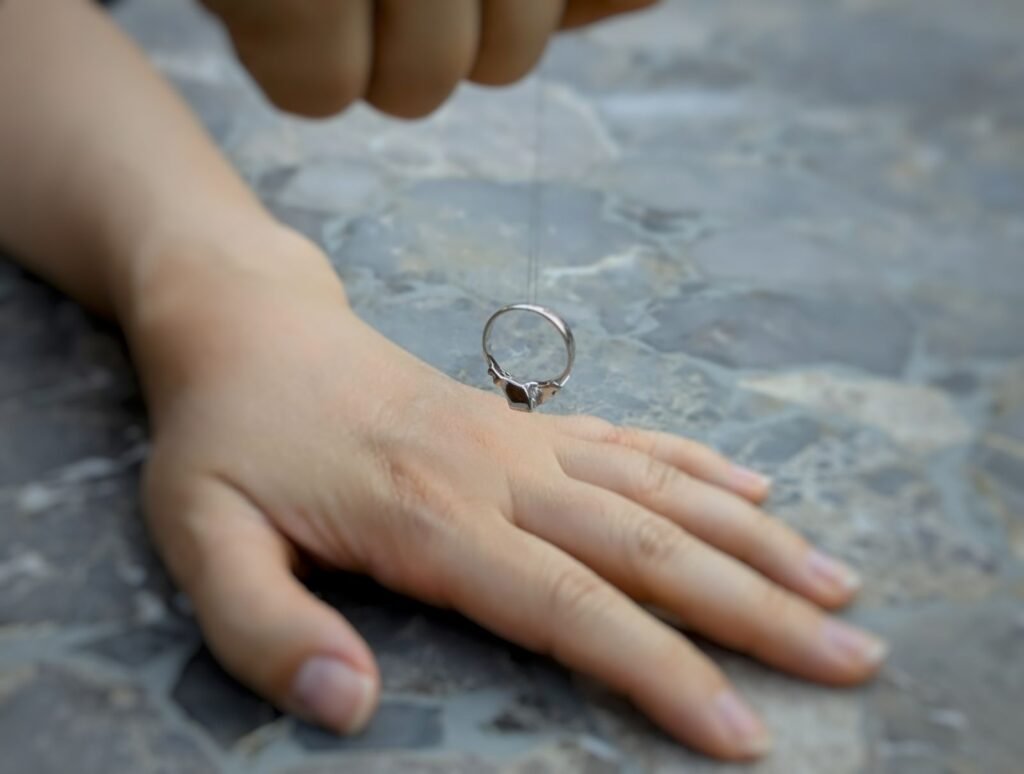
Left image of version one and right image is of version two
Version Two: Above the Participant’s Left Hand
- Place your left hand on a flat surface.
- Hold the threaded ring above your left hand.
- Gently swing the ring between each of your fingers, tracing your hand from pinky to thumb.
- Immediately trace backward, thumb to pinky, ending where you began and holding the ring above the center of your hand.
- Interpret the movement:
• Back-and-forth swinging predicts a girl.
• Circular movement suggests a boy. - Sit the ring on top of your hand again.
- Repeat the tracing process until the ring stops moving completely. Each time you trace your hand, it is said to predict the gender of a different child. The total number of times the ring moves before it stops is believed to indicate the number of children you will have. The pattern of movements—whether swinging back and forth or in circles—suggests the order and genders of your future children.
- For a visual guide, please see the video on how the ring method works.
Accuracy and Beliefs
The ring gender test is a fun old wives’ tale that many people enjoy trying, but it’s important to remember it’s not scientifically proven. Some believe that the ring’s movements are influenced by things like energy fields or unconscious hand motions, but there’s no solid evidence to back this up.
Many parents give the ring method a try around the second trimester, usually between 18 and 20 weeks, which is also when an ultrasound can typically reveal the baby’s gender. It’s a fun way to guess the baby’s sex and see if it matches up with what the ultrasound later shows!
While using the ring method can definitely make guessing your baby’s gender more exciting, keep in mind that its accuracy is hit or miss. Some people find it surprisingly accurate, with the ring correctly predicting the baby’s gender in their cases, but this isn’t guaranteed for everyone. An ultrasound provides a much clearer and more reliable answer.
So, go ahead and enjoy the ring method as a fun tradition, and remember that the best part is preparing to welcome your new baby, no matter what the predictions say! Interested in how the ring method worked for me and my family? Check out my personal story here.